
Best Nordic Country for International Students: 2026 Comparison
Compare Norway, Sweden, Denmark, Finland and Iceland for international students by tuition, scholarships, English-taught programs, housing, work and post-study options.
Researched and updated by Nordic Life Guide Research Desk
Quick answer
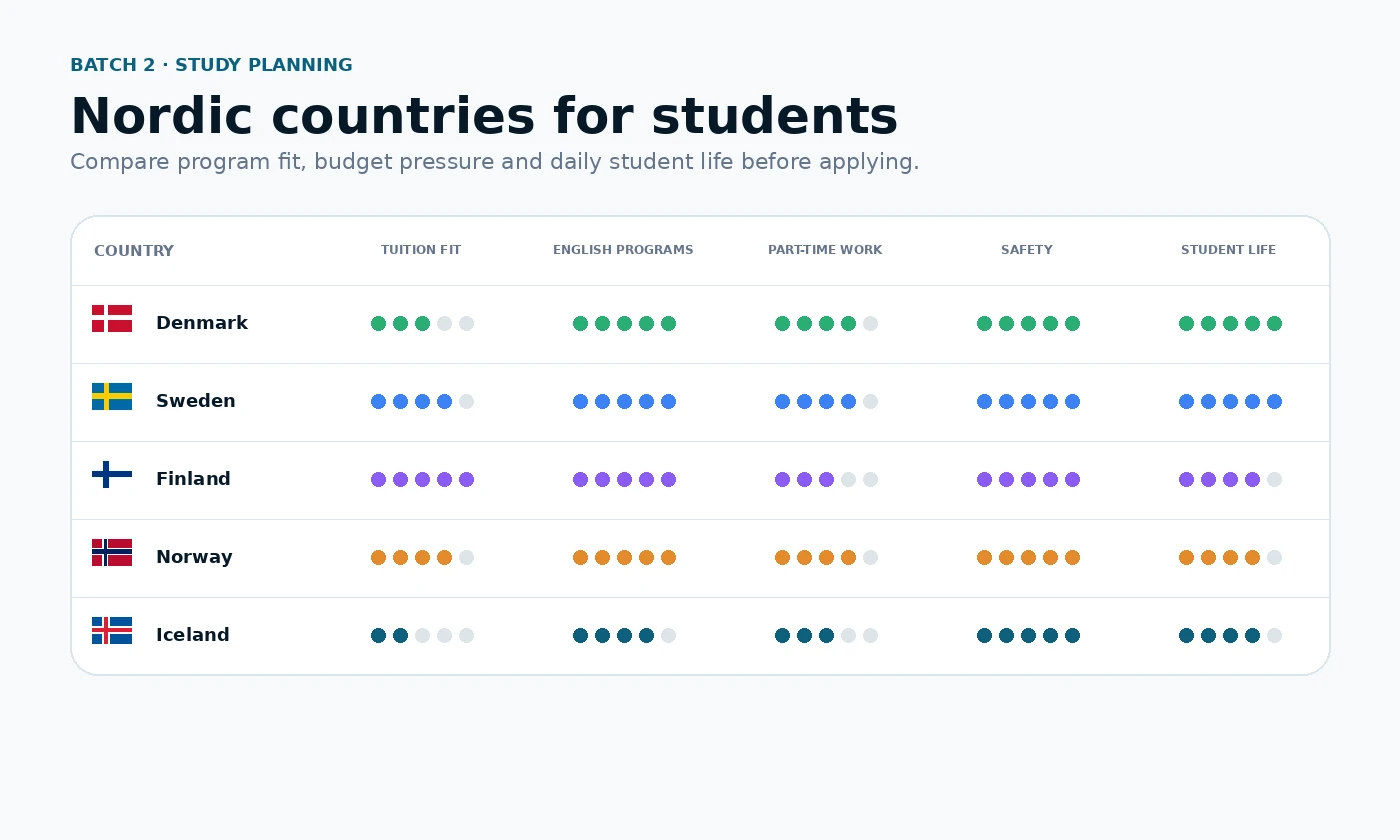
There is no single best Nordic country for every international student. Start with programmes you can actually enter and afford, then compare tuition status, housing, residence rules, monthly funding and post-study career fit. As a broad 2025 household-consumption price benchmark with EU=100, Finland was 126.1, Sweden 128.4, Norway 138.4, Denmark 140.2 and Iceland 183.7. Those figures are not student budgets, but they show why country choice should be tested with your actual rent, tuition and funding rather than lifestyle reputation.
Updated: 2026-09-14
Sources checked: 2026-09-14
On this page
- 1. Compare programmes before countries
- 2. Use a comparable price baseline, then replace it with your student budget
- 3. Housing can decide the student experience
- 4. Treat part-time income as a scenario, not guaranteed funding
- 5. Add the post-study question before accepting
- Compare the career bridge after the degree, not only the student experience
What to know first
- Programme and admission fit comes before country ranking.
- 2025 national price-level benchmark: Finland 126.1, Sweden 128.4, Norway 138.4, Denmark 140.2, Iceland 183.7 (EU=100).
- Tuition and fee status can depend on nationality, programme and institution, so verify the official study portal and university.
- Do not build a plan that only works if you immediately find part-time work.
- Use the Nordic student-budget calculator with your own rent, funding and tuition status.
Before you decide
Use this guide for the right situation
Who this guide is for
International students comparing Norway, Denmark, Sweden, Finland and Iceland.
What it covers
Programme-first comparison with a harmonized price baseline, housing, funding and route checks.
Also check separately
Next step: Shortlist real programmes, enter your tuition/rent/funding in the student-budget calculator, then verify the residence and work rules for your nationality.
Key facts
Key facts used in this guide
- Finland price level
- 126.1
2025 household-consumption price level, EU=100; not a student budget.
Comparable Nordic benchmark
2025 household-consumption price levels
For cross-country comparisons, a single harmonised dataset is more useful than mixing unrelated cost-of-living websites. Eurostat's 2025 price-level index sets the EU average at 100. It describes broad national consumer prices, not your personal rent or monthly budget.
| Country | Index (EU=100) | What it means |
|---|---|---|
| Finland | 126.1 | Above 100 means the broad household-consumption price level was above the EU average. |
| Sweden | 128.4 | Above 100 means the broad household-consumption price level was above the EU average. |
| Norway | 138.4 | Above 100 means the broad household-consumption price level was above the EU average. |
| Denmark | 140.2 | Above 100 means the broad household-consumption price level was above the EU average. |
| Iceland | 183.7 | Above 100 means the broad household-consumption price level was above the EU average. |
Eurostat — Comparative price levels in Europe, 2025 ↗ · 2025 reference period · checked 8 August 2026.
1. Compare programmes before countries
Build a shortlist from programmes that match your academic background, language, deadlines and career goal. Use Study in Norway, Study in Denmark, Study in Sweden, Study in Finland and Study in Iceland as national starting points, then verify details with the institution itself.
A country cannot be your best student destination if the right programme is unavailable, admission timing does not work or the tuition/status rules make it unaffordable.
Evidence for this section: Study in Norway ↗ · Study in Denmark ↗ · Study in Sweden ↗ · Study in Finland ↗ · Study in Iceland ↗
2. Use a comparable price baseline, then replace it with your student budget
Eurostat's 2025 household-consumption price-level index puts Finland and Sweden below Denmark and Norway, while Iceland is materially higher on this national measure. This is useful context because the same methodology covers all five countries.
It is not a ranking of student affordability. Dorm or shared-housing availability, tuition status, transport discounts and the city you choose can reverse the practical result. Use the index to frame the question, then enter your own rent and funding in the student budget tool.
Evidence for this section: Eurostat — Comparative price levels in Europe, 2025 ↗

3. Housing can decide the student experience
Check housing at the same time as the programme. A prestigious programme can become financially stressful if the only realistic housing is far above your planned rent or requires a large move-in payment.
Compare university or student-housing channels, current private listings, deposit/advance-payment terms and commute. Keep first-month cash separate from normal monthly living costs.
Evidence for this section: Study in Norway ↗ · Study in Denmark ↗ · Study in Sweden ↗ · Study in Finland ↗ · Study in Iceland ↗
4. Treat part-time income as a scenario, not guaranteed funding
Student work rights differ by nationality and residence route, while the job market differs by city, language and experience. Even where work is permitted, that does not guarantee a job in the first month.
Build one budget with expected part-time income and a second with that field at zero. If the study plan fails without immediate employment, you need a larger buffer or a different cost structure before committing.
Evidence for this section: Study in Norway ↗ · Study in Denmark ↗ · Study in Sweden ↗ · Study in Finland ↗ · Study in Iceland ↗
5. Add the post-study question before accepting
If your goal includes staying after graduation, compare the labour market for your field, local-language expectations and the current residence route after study. A slightly more expensive programme can be rational when it strongly improves the career path; a cheaper country can be the better choice when it gives equal programme quality and a safer budget.
Keep the study decision and immigration eligibility separate: verify the current authority rules for your nationality rather than assuming every graduate follows the same route.
Evidence for this section: UDI — Norwegian Directorate of Immigration ↗ · New to Denmark / SIRI ↗ · Swedish Migration Agency ↗ · Finnish Immigration Service (Migri) ↗ · Ísland.is ↗
Compare the career bridge after the degree, not only the student experience
A student destination becomes much more valuable when the programme, legal student-work conditions, graduate job-search route and first-job market connect. Compare the degree with the actual employers and occupation rules in the city where you would graduate; a generous scholarship cannot rescue a programme that leaves you with no realistic career bridge.
Use the post-study planner beside the student budget. The strongest shortlist is one where both the academic plan and the first-job path work without optimistic assumptions.
Evidence for this section: UDI — Job seekers: recent graduates and researchers ↗ · Swedish Migration Agency — Look for work after studies ↗ · New to Denmark — Job seeking after higher education ↗ · Migri — Residence permit to look for work after studies or research ↗ · Iceland Directorate of Immigration — 2026 graduate job-search change ↗
Still comparing?
Find a better country shortlist.
Use the quiz to narrow your research, then compare the result with the guides and current sources.
Useful tools
Try the numbers or checklist yourself.
Comparison
Best Nordic Country Quiz: Find Your Best Fit for Work, Study or Life
Choose a planning profile and transparent evidence weights to shortlist Nordic countries using comparable price-level, unemployment and annual-hours data, then verify legal, job, housing and city factors separately.
Cost of living
Nordic Cost of Living Comparison Tool (2026)
Compare Norway, Denmark, Sweden, Finland and Iceland using Eurostat's 2025 household-consumption price-level index, with a transparent reference-budget scaling tool.
Study
Nordic Student Budget Calculator
Build a Norway, Denmark, Sweden, Finland or Iceland student budget from your actual funding, rent, tuition status, transport, study costs and part-time income assumption.
Study
Nordic Post-Study Route Planner
Map the graduation-to-job sequence in Norway, Denmark, Sweden, Finland or Iceland: post-study status, timing, job-search focus and the next employee-permit check.
Work
Nordic Job Search Planner
Build a job-search route around the official national job portal, your work-right situation, working language and whether your profession needs formal authorisation.
FAQ
Frequently asked questions
Which Scandinavian country is best for international students?
There is no universal winner. Sweden and Denmark can offer broad international study ecosystems, Norway can be strong for selected programmes, and Finland often compares well on the broad national price-level benchmark. Programme, tuition status and housing decide the personal answer.
Which Nordic country is cheapest for students?
Do not infer a student budget from the national price index alone. Finland has the lowest 2025 household-consumption price level of the five in this comparison, but tuition status, city rent and student housing can change the result.
Should I rely on part-time work to fund Nordic study?
No. Treat it as an optional scenario until you have verified work rights and actual job prospects. Run a budget with part-time income set to zero as a stress test.
How we check this guideSources, boundaries and update checks
- Time-sensitive rules and statistics are linked to primary or official sources where available.
- Planning guidance is kept separate from legal eligibility, live availability and personal financial advice.
- Important dates and source checks are shown so you can re-verify changing information before acting.
Sources
Official and primary references
Open the references if you need to verify a rule, statistic or date before making a decision.
View 16 sources and verification dates
Official national information for international students considering Norway.
Data period: Current guidance
Checked: 2026-07-26
Official national portal for international higher-education planning in Denmark.
Data period: Current guidance
Checked: 2026-07-26
Official national portal for international students considering Sweden.
Data period: Current guidance
Checked: 2026-07-26
Official national information for international students considering Finland.
Data period: Current guidance
Checked: 2026-07-26
Official national information for international students considering Iceland.
Data period: Current guidance
Checked: 2026-07-26
Official Eurostat comparison of 2025 price-level indices with EU=100.
Data period: 2025
Checked: 2026-08-12
Official source for Norwegian immigration and residence permit information.
Checked: See page date
Official Danish immigration and work permit information.
Checked: See page date
Official Swedish immigration and residence permit information.
Checked: See page date
Official Finnish immigration source.
Checked: See page date
Iceland’s official public-service portal for residence, registration, health, education and daily-life services.
Data period: Current guidance
Checked: 2026-07-26
UDI has a specific job-seeker route for people who recently graduated in Norway or are researchers. The route has its own eligibility, funding, work-right and duration rules and must not be confused with the general skilled-worker permit.
Data period: Current 2026 guidance
Checked: 2026-09-14
The Swedish Migration Agency provides a residence-permit route for graduates who completed qualifying higher education in Sweden and want to look for work or explore starting a business after study.
Data period: 2026 guidance
Checked: 2026-09-14
SIRI explains that graduates of qualifying state-approved Danish higher-education programmes may receive a 6-month or 3-year job-seeking period depending on programme type and route, with specified work rights during job seeking.
Data period: 2026 guidance
Checked: 2026-09-14
Migri states that eligible graduates and researchers can receive a residence permit to look for work or start a business for a maximum of two years, and the permit can be used in parts under the current rules.
Data period: Current 2026 guidance
Checked: 2026-09-14
Iceland's 2026 amendments allow qualifying graduates of Icelandic bachelor's, master's or doctoral degrees to renew student residence for up to 18 months to seek employment based on their qualifications.
Data period: Rules effective 2026
Checked: 2026-09-14
Read next
Continue your research
Nordic Job Market Comparison 2026: Jobs, Unemployment, Shortages & Permits
Compare Norway, Denmark, Sweden, Finland and Iceland using current unemployment data, official shortage signals, job portals, language and permit reality.
Nordic Housing Affordability 2026: Rent vs Salary in Major Cities
Compare Nordic housing affordability through rent-to-income pressure, move-in cash, city differences and the trade-off between headline salary and real housing access.
Nordic Work-Life Balance Comparison 2026: Hours, Leave & Daily Reality
Compare Denmark, Norway, Sweden, Finland and Iceland using 2025 work-hours data, parental-leave structure and the daily trade-offs that affect real work-life balance.
Nordic Student Budget Calculator
Build a Norway, Denmark, Sweden, Finland or Iceland student budget from your actual funding, rent, tuition status, transport, study costs and part-time income assumption.
Nordic Scholarships for International Students: Where to Look and What They Really Cover
Compare how scholarship searches work in Norway, Denmark, Sweden, Finland and Iceland, including university awards, tuition waivers, living-cost gaps and common misleading claims.
Nordic Tuition Fees Compared: Norway, Sweden, Denmark, Finland and Iceland
Compare the tuition-fee decision across the five Nordic countries without assuming 'Nordic university is free', including citizenship/status differences and institution-level verification.
English-Taught Programs in the Nordic Countries: How to Find the Right Degree
Search official programme databases in Norway, Denmark, Sweden, Finland and Iceland, then narrow English-taught degrees by level, subject, tuition, admissions and career fit.
Student Housing in the Nordic Countries: How to Budget, Search and Avoid a Bad Plan
Plan student housing in Norway, Denmark, Sweden, Finland and Iceland using official study portals, realistic move-in cash, fallback options and city-level housing checks.
Working While Studying in the Nordics: 2026 Rules Compared
Compare 2026 international-student work rules in Norway, Sweden, Denmark, Finland and Iceland, then plan jobs and budgets safely.
Study in Denmark vs Finland: Tuition, English Programs, Work and Living Costs
Compare Denmark and Finland for international study by tuition status, scholarships, English-taught programs, student work, housing and post-study planning.
Study to Work in the Nordics After Graduation: 2026 Routes
Compare post-study job-search and work transitions in Norway, Denmark, Sweden, Finland and Iceland after a Nordic degree.
Nordic Graduate Job Search Plan: Final Semester to First Full-Time Job
A practical 16-week study-to-work plan for international graduates: employers, CV, licensing, language, permits, interviews and offers.
Official Nordic Job Portals: Where Foreigners Should Search First
Use the official job-search starting points in Norway, Denmark, Sweden, Finland and Iceland before relying on generic vacancy aggregators.