
Norway Tax Calculator Guide: Salary After Tax
Estimate Norway salary after tax, understand the main assumptions and compare take-home pay with rent and living costs.
Researched and updated by Nordic Life Guide Research Desk
Quick answer
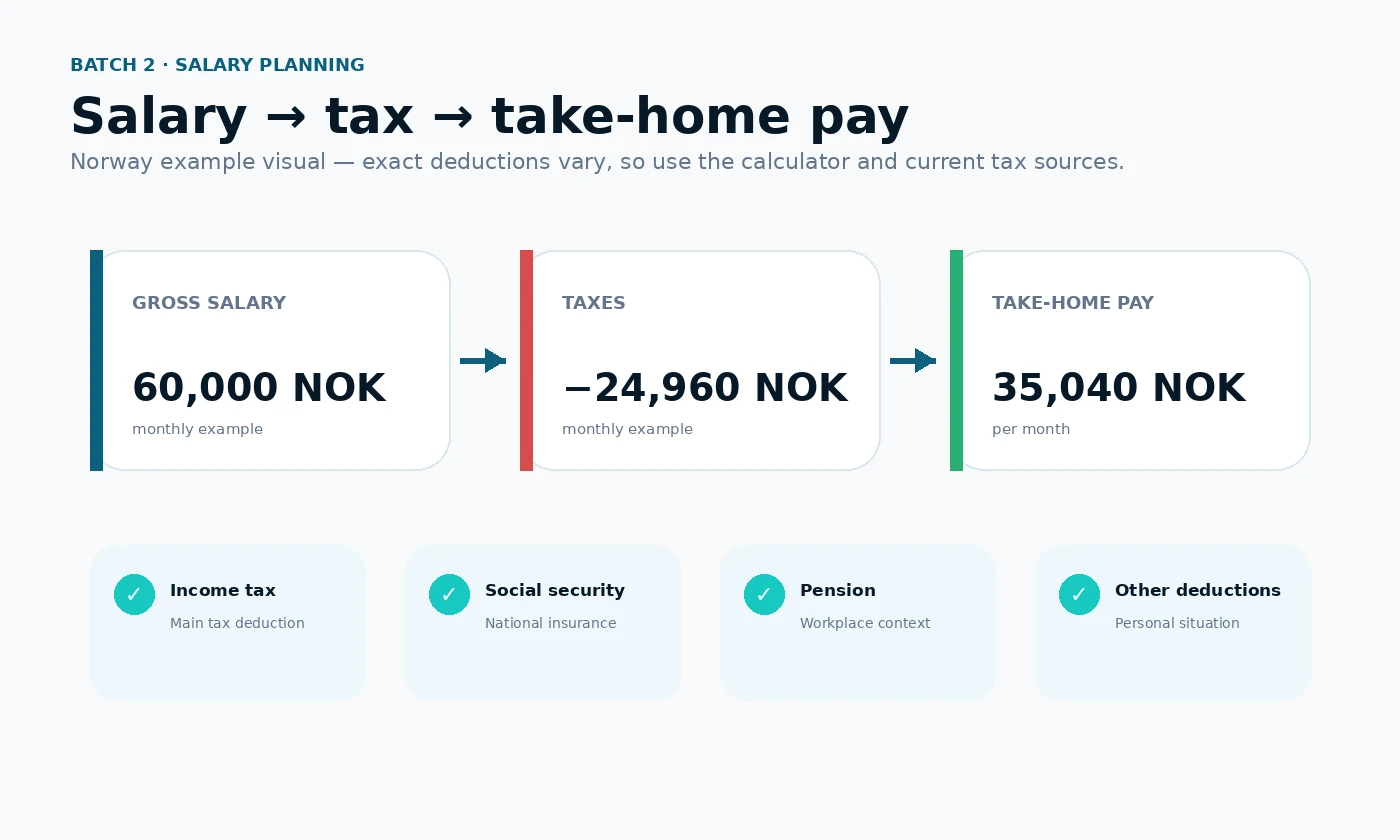
Norway salary after tax depends on your tax card, municipality, deductions and personal situation. For relocation planning, the key number is not gross salary but monthly take-home pay after rent, food, transport, utilities and savings.
Updated: 2026-08-08
Sources checked: 2026-08-08
What to know first
- Use net salary, not gross salary, for living-cost planning.
- Tax depends on personal details and primary tax-card information.
- Rent can quickly change whether a salary feels comfortable.
- Use primary tax sources for exact results.
Before you decide
Use this guide for the right situation
Who this guide is for
Foreign workers and job seekers evaluating Norway.
What it covers
Covers job-market fit, work permission, employer evidence, salary and the next operational step.
Also check separately
Next step: Check a current vacancy or offer against the official work/residence route and the relevant salary/cost tool.
Current official-data context
Numbers worth checking before you decide
These figures give the guide a current factual baseline. They are reference points, not promises about your personal salary, tax bill, rent or eligibility.
- Average monthly earnings
- NOK 63,630
- Ordinary income tax
- 22%
- Employee National Insurance
- 7.6%
- 2026 labour shortage
- ~34,000 people
- Skilled-worker salary floor
- NOK 545,400 / 624,700
- 2025 price level
- 138.4 (EU=100)
All industries, Q1 2026; an average, not a starting salary or guaranteed offer.
Applied to taxable ordinary income after relevant deductions; bracket tax and National Insurance are separate.
Norwegian Tax Administration — Advance tax assessment 2026 ↗
2026 salary rate, subject to the official lower-limit/reduction rules.
Norwegian Tax Administration — Advance tax assessment 2026 ↗
NAV employer survey estimate; health/care and trade-certificate occupations show especially strong shortages.
Current UDI floors for bachelor-/master-requiring roles without a collective agreement, subject to route and normal-pay rules.
Country-level household-consumption price index; not a personal budget.
Source check: 2026-08-08. Recheck official sources before making a high-stakes financial, tax or immigration decision.
Why does salary after tax matter more than gross salary?
Gross salary helps compare offers, but your real budget depends on monthly take-home pay. Rent, transport, groceries, phone, insurance, savings and first-month setup costs all come from net income.
Before accepting an offer, make a monthly budget using conservative assumptions.
- Gross salary
- Estimated tax
- Monthly net income
- Rent and living costs
What affects Norwegian take-home pay?
Tax can depend on income level, tax card, municipality, deductions and personal circumstances. Private calculators are useful for planning, but primary tax tools and employer payroll information should be used for final decisions.
For new arrivals, first-year assumptions can be especially important because housing and setup costs can be high.
- Income
- Tax card
- Deductions
- Municipality
- Personal situation
How should newcomers compare salary with living costs?
Use a rent-first calculation. If rent takes too much of your net income, even a high salary may feel tight. Add groceries, transport, utilities and savings before deciding if the offer fits your life.
A good rule is to compare several city scenarios before moving.
- Rent share
- Essential costs
- Savings buffer
- City differences
Use salary after tax together with rent
A Norway salary only becomes meaningful when compared with rent and monthly essentials. A high gross salary can still feel tight if rent is too high, while a moderate salary can work better in a cheaper city or shared housing.
Before accepting a job offer, build a simple net-income budget and test a conservative rent scenario.
- Estimate monthly take-home pay
- Subtract realistic rent first
- Add groceries, transport and utilities
- Keep a savings or emergency buffer
Salary mistakes newcomers make in Norway
The biggest mistake is converting a Norwegian salary to your home-country currency and assuming it will feel the same. Norway’s local prices, taxes, rent and transport costs need to be compared locally.
Another mistake is ignoring first-month costs such as deposits, furniture, winter clothing or temporary housing.
- Do not compare gross salary alone
- Do not ignore rent and deposits
- Plan first-month costs separately
- Use current tax and payroll information for final decisions
Useful tools
Try the numbers or checklist yourself.
Salary
Norway Salary Needed Calculator
Estimate the monthly net salary needed to live in Norway based on rent, household size, lifestyle and savings goals.
Salary
Norway Salary After Tax Calculator (2026)
Estimate Norway take-home pay from gross salary, then compare net income with rent, monthly costs and a savings target.
FAQ
Frequently asked questions
Is a Norway salary after tax calculator exact?
Private estimates are only planning shortcuts. Use it for planning, then verify with primary tax information or payroll guidance.
Should I compare salary before or after tax?
Use after-tax salary for living-cost planning.
What salary is good in Norway after tax?
A good salary depends on city, rent, household size and lifestyle. Compare estimated net pay with your actual monthly budget instead of relying on one national number.
Should I use gross or net salary for Norway planning?
Use net salary for daily-life planning. Gross salary is useful for job offers, but net pay is what covers rent, food, transport and savings.
How we check this guideSources, boundaries and update checks
- Time-sensitive rules and statistics are linked to primary or official sources where available.
- Planning guidance is kept separate from legal eligibility, live availability and personal financial advice.
- Important dates and source checks are shown so you can re-verify changing information before acting.
Sources
Official and primary references
Open the references if you need to verify a rule, statistic or date before making a decision.
View 7 sources and verification dates
Official tax source for Norway.
Checked: See page date
Official Norwegian statistics source.
Checked: See page date
Official quarterly earnings statistics. Average monthly earnings across all industries were NOK 63,630 in Q1 2026.
Data period: Q1 2026
Checked: 2026-08-08
Official 2026 thresholds and rates used for ordinary salary-tax planning, including bracket tax, National Insurance, personal allowance and minimum standard deduction.
Data period: 2026
Checked: 2026-08-08
NAV's 2026 employer survey estimates a national labour shortage of about 34,000 people. Health, care and nursing occupations account for the largest occupational shortage, and trade-certificate occupations also show substantial unmet demand.
Data period: Survey fieldwork January–March 2026; published 20 May 2026
Checked: 2026-08-12
For skilled-worker positions without a collective agreement, UDI currently states salary floors of NOK 624,700/year for positions requiring a master's degree and NOK 545,400/year for positions requiring a bachelor's degree, unless a lower salary is strongly documented as normal for the occupation and place.
Data period: Current guidance checked 12 August 2026
Checked: 2026-08-12
Official Eurostat comparison of 2025 price-level indices with EU=100.
Data period: 2025
Checked: 2026-08-12
Read next
Continue your research
Norway Salary After Tax Calculator (2026)
Estimate Norway take-home pay from gross salary, then compare net income with rent, monthly costs and a savings target.
Salary Needed to Live in Norway: Net Income Planning Guide
Estimate the salary you may need in Norway by comparing rent, groceries, transport, savings, household size, and lifestyle expectations.
Cost of Living in Norway: Monthly Budget Guide
Plan a realistic monthly budget for Norway including rent, groceries, transport, utilities, lifestyle, student costs, and city differences.