
Cheapest Nordic Country to Live In 2026: Price, Tax & Housing Reality
Finland has the lowest 2025 national consumer price level of the five Nordics, but salary after tax and housing can reverse the affordability ranking.
Researched and updated by Nordic Life Guide Research Desk
Quick answer
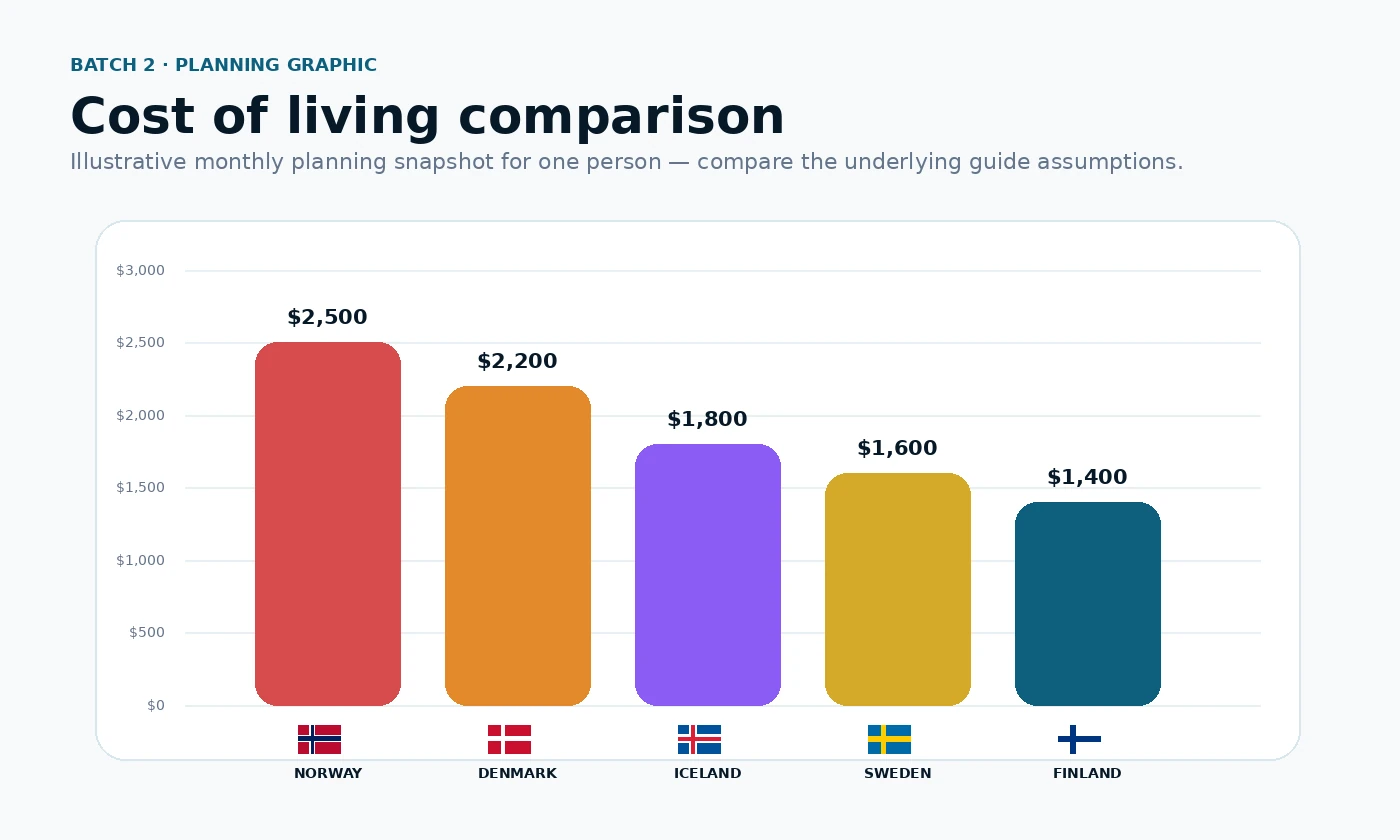
Finland is the cheapest of the five Nordic countries in Eurostat's 2025 household-consumption price-level index at 126.1 (EU=100), followed by Sweden 128.4, Norway 138.4, Denmark 140.2 and Iceland 183.7. But that is not an affordability ranking. OECD's standardized labour-tax measure and Eurostat housing-pressure data show why: Finland's tax wedge is higher than Norway/Denmark in the single-worker scenario, while Denmark has especially high housing pressure. Use the national price level to shortlist, then compare real city rent with your after-tax income.
Updated: 2026-08-17
Sources checked: 2026-08-17
On this page
- The 2025 Nordic price-level ranking
- Why Finland ranks as the cheapest Nordic country in this dataset
- Why Sweden is the second budget-first option
- Why Norway and Denmark are closer than the stereotype
- Why Iceland is the most expensive in the 2025 comparison
- How to find the cheapest Nordic country for you
- Method and limitations
- Cheapest Nordic country vs most affordable country
- How Nordic living costs usually differ by country
- How to compare costs before moving
What to know first
- Cheapest country is not the same as best affordability.
- Rent and salary must be compared together.
- Capital cities can change the result completely.
- A smaller city with fewer jobs may not be cheaper if income is lower.
Before you decide
Use this guide for the right situation
Who this guide is for
Budget-sensitive movers, students and remote-income households.
What it covers
Ranks price pressure and affordability inputs; it does not rank jobs, visa access or overall happiness.
Also check separately
Next step: Compare the chosen city rent and take-home income after using the country-level ranking.
Key facts
Key facts used in this guide
Comparable Nordic benchmark
2025 household-consumption price levels
For cross-country comparisons, a single harmonised dataset is more useful than mixing unrelated cost-of-living websites. Eurostat's 2025 price-level index sets the EU average at 100. It describes broad national consumer prices, not your personal rent or monthly budget.
| Country | Index (EU=100) | What it means |
|---|---|---|
| Finland | 126.1 | Above 100 means the broad household-consumption price level was above the EU average. |
| Sweden | 128.4 | Above 100 means the broad household-consumption price level was above the EU average. |
| Norway | 138.4 | Above 100 means the broad household-consumption price level was above the EU average. |
| Denmark | 140.2 | Above 100 means the broad household-consumption price level was above the EU average. |
| Iceland | 183.7 | Above 100 means the broad household-consumption price level was above the EU average. |
Eurostat — Comparative price levels in Europe, 2025 ↗ · 2025 reference period · checked 8 August 2026.
2025 comparison data
A comparable price baseline across all five countries
The table uses Eurostat’s 2025 price-level index for household final consumption expenditure. EU=100. It is a country-level price comparison, not a personal monthly budget or a salary-adjusted affordability score.
| Country | 2025 price level | Price rank | Strong starting point for |
|---|---|---|---|
| Finland | 126.1 | #1 of 5 | Lowest national price level in this five-country Eurostat comparison |
| Sweden | 128.4 | #2 of 5 | Second-lowest price level in this five-country baseline |
| Norway | 138.4 | #3 of 5 | Lowest broad unemployment rate in this five-country snapshot |
| Denmark | 140.2 | #4 of 5 | Lowest annual-hours measure in the five-country OECD comparison |
| Iceland | 183.7 | #5 of 5 | Relatively low broad unemployment in the latest comparable release |
Source and period: Eurostat — Comparative price levels in Europe, 2025 ↗ · 2025 · checked 2026-08-17. The ranking above is price-level order only.
What our data shows
Nordic Life Guide analysis
Finland ranks first on price alone in our five-country 2025 Nordic baseline at 126.1 with EU=100, followed by Sweden at 128.4. This is a price-level ranking, not a salary-adjusted affordability ranking.
Supporting data: Nordic Cost Pressure Baseline 2025.
Quick comparison
The main trade-offs
The 2025 Nordic price-level ranking
Eurostat's 2025 comparative price-level index sets the EU average to 100 and compares household final consumption expenditure. The five-country order is Finland 126.1, Sweden 128.4, Norway 138.4, Denmark 140.2 and Iceland 183.7.
Because every country uses the same measure, this is a much better answer to 'which Nordic country is cheapest?' than a list built from crowd-sourced restaurant prices or a single city. It still measures national price level, not the exact monthly costs of your household.
- 1. Finland — 126.1
- 2. Sweden — 128.4
- 3. Norway — 138.4
- 4. Denmark — 140.2
- 5. Iceland — 183.7
Evidence for this section: Eurostat — Comparative price levels in Europe, 2025 ↗
Why Finland ranks as the cheapest Nordic country in this dataset
Finland's 126.1 index value is the lowest among the five countries in the 2025 Eurostat comparison. For a person starting with a strict cost constraint, Finland is therefore the most defensible first country to research.
The ranking should not be stretched into a claim that every Finnish city or household is cheap. Housing, heating, transport, lifestyle and income still matter. A student in one city and a family renting a larger home in another can have very different budgets.
- Use Finland as the budget-first starting point
- Compare the actual study or work city
- Add housing before judging affordability
- Check income and residence route separately
Evidence for this section: Eurostat — Comparative price levels in Europe, 2025 ↗

Why Sweden is the second budget-first option
Sweden's 2025 price-level index is 128.4, only 2.3 points above Finland. The country also offers more large-city choices than Finland, which can be useful for job and study research.
The main warning is housing. A national price-level index does not solve the difficulty of finding suitable housing in a specific city. A Sweden budget should be built from the likely city and housing route, not only from the national rank.
- Price level: 128.4
- Compare Stockholm with other cities
- Treat housing access as a separate risk
- Count real vacancies or programmes before moving
Evidence for this section: Eurostat — Comparative price levels in Europe, 2025 ↗
Why Norway and Denmark are closer than the stereotype
Norway is 138.4 and Denmark 140.2 in the 2025 Eurostat comparison. That is a 1.8-point gap, so the broad national price measure does not support a simple story that Norway is dramatically more expensive than Denmark in every form of household consumption.
For a mover, the better question is whether income and city housing offset the price level. A strong Norwegian job offer can produce a better personal margin than a weaker offer in a country with a lower index. Affordability is price relative to resources, not price alone.
- Norway: 138.4
- Denmark: 140.2
- Compare net income with city rent
- Do not rank from grocery anecdotes
Evidence for this section: Eurostat — Comparative price levels in Europe, 2025 ↗
Why Iceland is the most expensive in the 2025 comparison
Iceland's 183.7 price-level index is far above the other four countries in the 2025 Eurostat data. For a budget-first mover, it should therefore be treated as a high-cost option that needs a strong reason such as a specific job, study route or lifestyle goal.
This does not mean nobody should choose Iceland. It means the cost assumption should be explicit from the beginning and the cash buffer should be built around the actual housing and income situation.
- Price level: 183.7
- Highest of the five-country comparison
- Use a larger budget buffer
- Choose for a specific route, not because it seems similar in price to mainland Nordics
Evidence for this section: Eurostat — Comparative price levels in Europe, 2025 ↗
How to find the cheapest Nordic country for you
Start with the Eurostat rank to narrow the field, then replace country averages with personal inputs. Use the city you would actually live in, likely housing type, estimated net income, transport, household size and savings goal.
A simple comparison is monthly net income minus rent and fixed essentials. Run the same assumptions for two countries. The cheapest price level may not produce the strongest financial margin if your profession has much better pay or job access elsewhere.
- Shortlist two countries
- Choose a real city
- Estimate net income
- Add realistic rent
- Compare remaining monthly margin
Evidence for this section: Eurostat — Comparative price levels in Europe, 2025 ↗
Method and limitations
The ranking on this page is the ascending order of Eurostat's 2025 household final consumption expenditure price-level index for Finland, Sweden, Norway, Denmark and Iceland. EU=100. No hidden lifestyle score is used to decide the cheapest country.
Nordic Life Guide then adds editorial planning guidance about how to turn a price-level rank into a personal budget. Those planning steps are not official statistics and are labelled as such.
Evidence for this section: Eurostat — Comparative price levels in Europe, 2025 ↗
Cheapest Nordic country vs most affordable country
People often search for the cheapest Nordic country, but the better question is affordability. A country can have lower prices but also lower salary or fewer relevant jobs. Another country can look expensive but still work if your net income is strong.
Compare rent, income, tax, transport and lifestyle together. Do not make the decision from grocery prices alone.
- Cheapest means lower spending in some categories
- Affordable means your income covers the lifestyle comfortably
- Rent is often the biggest monthly difference
- Capital cities are usually more expensive than smaller cities
How Nordic living costs usually differ by country
Each Nordic country has different cost patterns. The exact result changes by city, household size and income, but a practical comparison can help you choose which country to research first.
Use the comparison as a planning shortcut, then check current rental listings and salary data before acting.
- Norway: high costs but potentially strong salaries in selected sectors
- Denmark: strong salaries and work-life balance, with Copenhagen housing pressure
- Sweden: larger market and varied city costs, with rental competition in big cities
- Finland: can be attractive for students and value-focused planning, depending on city
- Iceland: beautiful lifestyle but costs and rental supply need careful checking
How to compare costs before moving
Build a simple monthly budget for each country using the same categories. Then compare it with expected net salary or savings. This makes the decision practical instead of based on general opinions.
If one country looks cheaper, test the city where you would actually live. A cheaper national average does not help if your chosen city or housing type is expensive.
- Choose one target city per country
- Estimate rent, food, transport and utilities
- Compare with expected net salary
- Add deposit and first-month setup costs
- Use the Nordic cost comparison tool before shortlisting
Still comparing?
Find a better country shortlist.
Use the quiz to narrow your research, then compare the result with the guides and current sources.
Useful tools
Try the numbers or checklist yourself.
Comparison
Nordic Country Comparison Tool
Weight comparable price-level, unemployment and annual-hours evidence across Norway, Denmark, Sweden, Finland and Iceland, then use the result as a shortlist before checking visas, jobs, housing and city costs.
Comparison
Best Nordic Country Quiz: Find Your Best Fit for Work, Study or Life
Choose a planning profile and transparent evidence weights to shortlist Nordic countries using comparable price-level, unemployment and annual-hours data, then verify legal, job, housing and city factors separately.
Cost of living
Nordic Cost of Living Comparison Tool (2026)
Compare Norway, Denmark, Sweden, Finland and Iceland using Eurostat's 2025 household-consumption price-level index, with a transparent reference-budget scaling tool.
FAQ
Frequently asked questions
What is the cheapest Nordic country to live in?
Finland is the lowest of the five countries in Eurostat's 2025 household-consumption price-level index at 126.1 with EU=100.
What is the cheapest Scandinavian country?
Among Denmark, Norway and Sweden, Sweden has the lowest 2025 Eurostat price-level index at 128.4, compared with Norway at 138.4 and Denmark at 140.2.
Is Sweden cheaper than Norway?
On Eurostat's 2025 household-consumption price-level index, Sweden is 128.4 and Norway 138.4. Personal affordability still depends on salary, rent and city.
Is Finland cheaper than Sweden?
Finland is slightly lower in the 2025 price-level data at 126.1 versus Sweden at 128.4.
Is Finland the cheapest Nordic country?
Finland may be more affordable in some scenarios, but the result depends on city, housing and income.
Is Norway too expensive to live in?
Norway can be expensive, but higher salaries in some sectors can make it workable if rent and budget are realistic.
Which Nordic country has the cheapest rent?
Rent varies more by city than by country. Compare the exact city and housing type you would use.
How we check this guideSources, boundaries and update checks
- Time-sensitive rules and statistics are linked to primary or official sources where available.
- Planning guidance is kept separate from legal eligibility, live availability and personal financial advice.
- Important dates and source checks are shown so you can re-verify changing information before acting.
Sources
Official and primary references
Open the references if you need to verify a rule, statistic or date before making a decision.
View 6 sources and verification dates
Official Eurostat comparison of 2025 price-level indices with EU=100.
Data period: 2025
Checked: 2026-08-12
OECD's 2026 edition provides standardized 2025 tax-wedge comparisons. For a single worker without children at the average wage, the total tax wedge was 35.8% in Denmark, 42.5% in Finland, 31.5% in Iceland, 36.4% in Norway and 41.1% in Sweden. The measure includes income tax and employee/employer social contributions relative to labour cost and is not the same as an individual's income-tax rate.
Data period: 2025 data, published 2026
Checked: 2026-08-17
Eurostat's 2025 housing publication uses 2024 data for several affordability indicators. It reports Denmark's housing costs at 86% above the EU average, a 23% housing-cost-overburden rate in Danish cities, and housing costs equal to 26% of disposable income in Denmark and 25% in Sweden. The overburden indicator means housing costs exceed 40% of disposable income.
Data period: 2024 data, 2025 publication
Checked: 2026-08-17
Official Danish rent-index source, updated 14 July 2026. The private-rental sample covers about 110,000 dwellings out of roughly 500,000 privately owned rentals.
Data period: Q2 2026
Checked: 2026-08-08
Official 2025 rental statistics. Greater Stockholm average monthly rent was SEK 141 per square metre; average rent change from 2024 was 4.7%.
Data period: 2025
Checked: 2026-08-08
Official Q2 2026 rent release. Non-subsidised rents decreased 0.3% year on year in Greater Helsinki while rising 0.4% in the rest of Finland.
Data period: Q2 2026
Checked: 2026-08-08
Read next
Continue your research
Nordic Housing Affordability 2026: Rent vs Salary in Major Cities
Compare Nordic housing affordability through rent-to-income pressure, move-in cash, city differences and the trade-off between headline salary and real housing access.
Nordic Tax Comparison 2026: Norway vs Sweden vs Denmark vs Finland vs Iceland
Compare Nordic taxes without the misleading 'highest tax' shortcut: income tax, social charges, VAT context, salary take-home and what workers should check country by country.
Nordic Salary Comparison 2026: Compare Pay Without Misreading Averages
Compare current official salary benchmarks, then turn a real Nordic job offer into after-tax purchasing power and city affordability.
Finland vs Sweden: Which Is Better to Live In? (2026)
Compare Finland and Sweden for cost, jobs, tax, housing, English, study and family life using current 2025–2026 evidence and city-level next steps.