
Norway vs Denmark: Which Is Better to Live In? (2026)
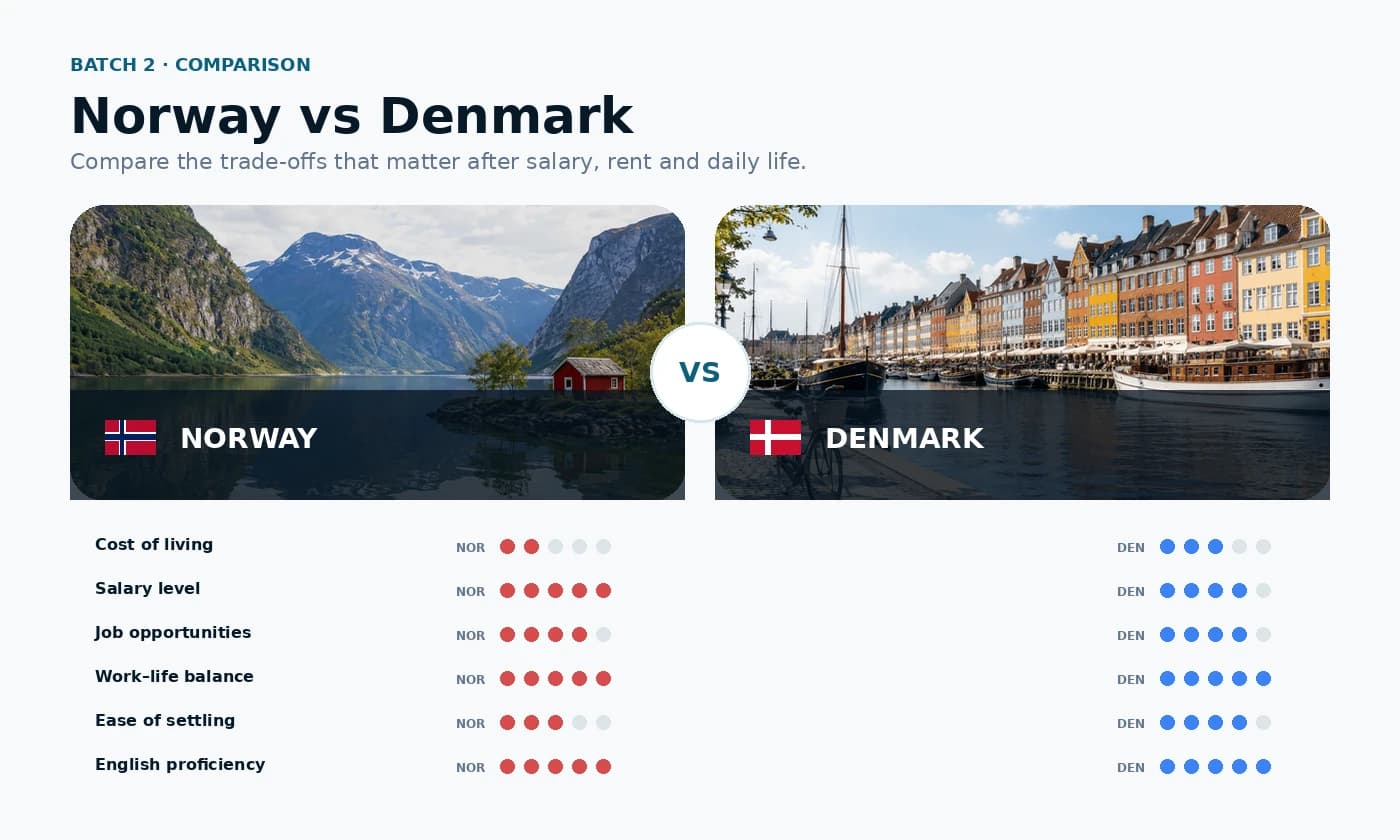
Norway usually wins on salary potential and nature; Denmark often wins on compact city life. Compare jobs, tax, rent, family routines and permits.
Researched and updated by Nordic Life Guide Research Desk
Quick answer
Norway and Denmark solve different relocation problems. Norway currently has the stronger broad labour-market signal—4.7% unemployment in Eurostat's May 2026 comparison versus 6.9% in Denmark, alongside NAV's documented worker shortage. Denmark has the lower standardized 2025 single-worker tax wedge (35.8% vs 36.4%) and lower OECD annual hours worked (1,369 vs 1,386), but Eurostat shows unusually high Danish housing pressure. Do not pick from reputation: compare your occupation, actual offer, city rent, work schedule and residence route.
Updated: 2026-08-17
Sources checked: 2026-08-17
On this page
- Norway or Denmark: the quick verdict by person
- Is Norway more expensive than Denmark?
- Which is better for work: Norway or Denmark?
- What about salaries in Norway vs Denmark?
- Which is better for families?
- Which is easier for English-speaking foreigners?
- A practical Norway vs Denmark decision test
- Norway vs Denmark: quick decision answer
- Which is better for jobs and salary?
- Which is better for families, students and language?
What to know first
- Norway may suit salary and nature-focused plans better.
- Denmark may suit work-life balance, families and Copenhagen career routes better.
- Rent, tax, salary and language should be compared together, not separately.
- Choose by sector and city, not only by country reputation.
Before you decide
Use this guide for the right situation
Who this guide is for
Workers, students and families with a realistic route to either Norway or Denmark.
What it covers
Compares the full living decision: salary after tax, housing, work, family routines, cities and residence practicality.
Also check separately
Next step: Insert the two actual city, salary and housing options into the comparison.
Key facts
Key facts used in this guide
Comparable Nordic benchmark
2025 household-consumption price levels
For cross-country comparisons, a single harmonised dataset is more useful than mixing unrelated cost-of-living websites. Eurostat's 2025 price-level index sets the EU average at 100. It describes broad national consumer prices, not your personal rent or monthly budget.
| Country | Index (EU=100) | What it means |
|---|---|---|
| Finland | 126.1 | Above 100 means the broad household-consumption price level was above the EU average. |
| Sweden | 128.4 | Above 100 means the broad household-consumption price level was above the EU average. |
| Norway | 138.4 | Above 100 means the broad household-consumption price level was above the EU average. |
| Denmark | 140.2 | Above 100 means the broad household-consumption price level was above the EU average. |
| Iceland | 183.7 | Above 100 means the broad household-consumption price level was above the EU average. |
Eurostat — Comparative price levels in Europe, 2025 ↗ · 2025 reference period · checked 8 August 2026.
Comparable data point
Norway and Denmark are closer on general price level than many people assume
Norway
138.4
2025 household-consumption price level, EU=100
Denmark
140.2
2025 household-consumption price level, EU=100
The gap is 1.8 index points in this Eurostat measure. That does not mean your personal budget will be almost identical: rent, city, tax, salary and household type can create a much larger difference.
Evidence: Eurostat — Comparative price levels in Europe, 2025 ↗ · 2025 · checked 2026-08-17.
Like-for-like evidence
Norway vs Denmark: current structural trade-offs
Use this table to frame the decision, then move to your occupation and city. Tax wedge is a standardized OECD labour-cost measure, not payslip withholding, and annual hours are broad averages rather than your employer schedule.
| Signal | Norway | Denmark | What it means |
|---|---|---|---|
| Unemployment | 4.7% | 6.9% | May 2026 broad labour-market context; not personal hiring odds. |
| 2025 price level | 138.4 | 140.2 | Both are high-cost nationally; city rent and salary matter more. |
| 2025 tax wedge | 36.4% | 35.8% | Very close in the standardized single-worker scenario. |
| 2025 annual hours | 1,386 | 1,369 | Denmark is lower in the OECD series, but occupation/employer schedules vary. |
Primary sources: Eurostat — Unemployment, May 2026 ↗ · Eurostat — Comparative price levels in Europe, 2025 ↗ · OECD — Taxing Wages 2026 ↗ · OECD — Average annual hours actually worked per worker ↗ · Eurostat — Housing in Europe 2025 ↗
What our data shows
Nordic Life Guide analysis
Norway and Denmark are separated by only 1.8 index points in Eurostat's 2025 household-consumption price-level measure—138.4 for Norway and 140.2 for Denmark. Personal affordability can still diverge sharply because salary, tax, rent and household type are not included in that single index.
Supporting data: Nordic Cost Pressure Baseline 2025.
Quick comparison
The main trade-offs
Norway or Denmark: the quick verdict by person
For an engineer, energy specialist or skilled worker with a Norway-focused opportunity, Norway is the stronger first path. For a household that values compact urban routines, cycling and shorter everyday distances, Denmark is the stronger default. Neither answer is universal because the profession and city change the result.
The useful decision is not 'which country wins?' but 'which country gives this person the stronger first shortlist?' We therefore recommend comparing the same job, likely rent and residence route in one Norwegian and one Danish city.
- Skilled specialist: Norway first
- Family/city routine: Denmark first
- Budget-only decision: compare actual city housing
- No job offer yet: compare real vacancies before lifestyle
Evidence for this section: Eurostat — Comparative price levels in Europe, 2025 ↗
Is Norway more expensive than Denmark?
Not on every broad price measure. Eurostat's 2025 household final consumption price-level index is 138.4 for Norway and 140.2 for Denmark, with EU=100. Denmark is slightly higher in this country-level measure.
That 1.8-point gap should not be turned into a claim that Denmark is always more expensive for a person. A Copenhagen apartment, an Oslo commute, household size and local rent can dominate the monthly result. Use the index as a comparable baseline, then build a city-level budget.
- Norway: 138.4
- Denmark: 140.2
- Difference: 1.8 index points
- Measure: household final consumption expenditure, EU=100
Evidence for this section: Eurostat — Comparative price levels in Europe, 2025 ↗

Which is better for work: Norway or Denmark?
For work, profession should decide before country branding. Norway is a strong first comparison for energy, engineering and other specialist routes; Denmark can be stronger when the target employer or industry is concentrated around Copenhagen, Aarhus or another Danish business cluster.
Non-EU/EEA applicants should separate job search from residence eligibility. UDI says skilled-worker applicants normally need a job offer before applying for the relevant Norwegian residence permit. The Danish route should be checked against SIRI/New to Denmark for the applicant's exact scheme. Do not assume an English-language job automatically creates immigration eligibility.
- Search real roles in both countries
- Compare the same occupation
- Check permit route before relocation spending
- Use net income and likely rent, not gross salary headlines
Evidence for this section:
What about salaries in Norway vs Denmark?
Official salary headlines are easy to misuse. Statistics Norway publishes earnings statistics using Norwegian definitions and reference periods. Statistics Denmark's average-employee page publishes DKK 51,675 per month before tax and notes that the amount includes pension and is calculated from standardised hourly earnings translated to a full-time monthly salary.
Those figures are useful inside each country's planning process, but they are not a clean direct ranking because currencies, pension treatment, tax and statistical definitions differ. The better comparison is job offer to job offer: expected net pay minus realistic housing and fixed costs in the city you would actually choose.
- Compare exact offers
- Read the earnings definition
- Estimate net pay
- Subtract likely city rent
- Keep pension treatment visible
Evidence for this section:
Which is better for families?
Denmark is our stronger default for a family profile that gives high weight to daily-life practicality, commute and work-life fit. Norway can be the better family choice when a household already has a strong job match and income that comfortably absorbs the housing and day-to-day cost structure.
A family should compare two real weekly routines: where the adults work, likely housing area, commute, childcare or school logistics and the amount of income left after fixed costs. National lifestyle claims are less useful than a Monday-to-Friday model of life in Copenhagen, Aarhus, Oslo, Bergen or another likely city.
- Map a real weekly routine
- Use likely housing area
- Add commute cost and time
- Compare cash left after fixed costs
Which is easier for English-speaking foreigners?
Both countries have international workplaces, but English access is not evenly distributed across every occupation. Norway's official Arbeidsplassen guidance specifically notes that its job database can be searched for advertisements where English is specified as the working language. That is a useful search feature, not proof that English is enough for every role.
In both countries, local language ability expands the range of customer-facing, public-sector and locally regulated jobs. Treat English-only access as an occupation-level question and measure it by the vacancies you can actually apply for this month.
- Search by working language
- Count relevant vacancies
- Check regulated-role language rules
- Plan local-language learning
Evidence for this section:
A practical Norway vs Denmark decision test
Choose one Norwegian city and one Danish city. Find ten realistic vacancies for your occupation in each place, record the pay information you can verify, estimate net income, add realistic rent and compare the remaining monthly margin. Then check the residence route and the weekly routine you would actually live.
If Norway wins on job fit and financial margin, choose Norway. If Denmark wins on employer fit and daily-life routine, choose Denmark. If the answer is still close, the job offer should break the tie rather than a generic country ranking.
- 1. Pick one city in each country
- 2. Find ten realistic vacancies
- 3. Estimate net pay and rent
- 4. Verify residence route
- 5. Compare the weekly routine
Evidence for this section: Eurostat — Comparative price levels in Europe, 2025 ↗
Norway vs Denmark: quick decision answer
If you want fjords, mountain access, high-income potential in selected sectors and a smaller-country feel, Norway may be a stronger starting point. If you want Copenhagen, cycling infrastructure, a more compact international job scene and family-friendly daily life, Denmark may be easier to shortlist.
Neither country is automatically cheaper or better. The right answer depends on net salary, rent, visa route, language and the specific city you are comparing.
- Choose Norway first for nature, energy, maritime, engineering and salary-focused research
- Choose Denmark first for Copenhagen jobs, work-life balance and cycling/city lifestyle
- Compare Oslo vs Copenhagen before comparing the whole countries
- Check residence/work rules before making a final plan
Which is better for jobs and salary?
Job potential depends on your sector. Norway can be strong for energy, maritime, engineering, healthcare and selected specialist roles. Denmark can be strong for Copenhagen-based international companies, pharma, design, IT, logistics and professional services.
Salary should be compared after tax and rent. A higher salary can feel less impressive if housing and setup costs are also higher.
- Compare job ads in your exact occupation
- Estimate net salary, not only gross salary
- Check whether the employer can hire your nationality/status
- Compare rent near realistic commute areas
Which is better for families, students and language?
Families may prefer Denmark if they value compact cities, cycling and work-life balance, while Norway may suit families who prioritise outdoor life and nature access. Students should compare programs, fees, city budgets and residence rules rather than choosing by country image.
Language matters in both countries. English helps, but local language improves job access, integration and long-term comfort.
- Families: compare childcare, commute, housing and city size
- Students: compare tuition status, housing and program language
- Workers: compare sector demand and employer requirements
- Long-term movers: plan local language learning early
Still comparing?
Find a better country shortlist.
Use the quiz to narrow your research, then compare the result with the guides and current sources.
Useful tools
Try the numbers or checklist yourself.
Comparison
Nordic Country Comparison Tool
Weight comparable price-level, unemployment and annual-hours evidence across Norway, Denmark, Sweden, Finland and Iceland, then use the result as a shortlist before checking visas, jobs, housing and city costs.
Comparison
Best Nordic Country Quiz: Find Your Best Fit for Work, Study or Life
Choose a planning profile and transparent evidence weights to shortlist Nordic countries using comparable price-level, unemployment and annual-hours data, then verify legal, job, housing and city factors separately.
Cost of living
Nordic Cost of Living Comparison Tool (2026)
Compare Norway, Denmark, Sweden, Finland and Iceland using Eurostat's 2025 household-consumption price-level index, with a transparent reference-budget scaling tool.
FAQ
Frequently asked questions
Is Norway or Denmark better to live in?
Norway is a stronger first choice for specialist work and outdoor priorities; Denmark is a stronger default for compact city life and family/work-life routines. City and job fit can change the answer.
Is Norway more expensive than Denmark?
Eurostat's 2025 household-consumption price-level index is 138.4 for Norway and 140.2 for Denmark with EU=100, so Denmark is slightly higher on that broad measure. Personal budgets can differ much more by city and rent.
Which has better salaries, Norway or Denmark?
Do not rank the countries from headline averages alone because official earnings definitions, currencies, pension treatment and taxes differ. Compare actual job offers, estimated net pay and likely city rent.
Which is better for families, Norway or Denmark?
Denmark is our stronger default for compact daily routines; Norway can be better when profession and household income fit the higher-cost environment.
Is Norway better than Denmark for salary?
Norway can be strong for selected sectors, but the useful comparison is net salary after tax and rent in the city where you will live.
Is Denmark easier to live in than Norway?
Denmark may feel easier for some city lifestyles, especially Copenhagen and cycling culture, while Norway may suit people who value nature access and selected industries.
Should I move to Oslo or Copenhagen?
Compare your job options, rent, commute, language needs and budget in each city before deciding.
How we check this guideSources, boundaries and update checks
- Time-sensitive rules and statistics are linked to primary or official sources where available.
- Planning guidance is kept separate from legal eligibility, live availability and personal financial advice.
- Important dates and source checks are shown so you can re-verify changing information before acting.
Sources
Official and primary references
Open the references if you need to verify a rule, statistic or date before making a decision.
View 7 sources and verification dates
Eurostat's 2 July 2026 release reports May unemployment rates of 6.9% for Denmark, 10.6% for Finland, 8.7% for Sweden and 4.7% for Norway. Iceland's May figure was not available in the release; April was 5.8%. Eurostat notes that trend components are used for Finland, Sweden, Iceland and Norway in this monthly release.
Data period: April-May 2026
Checked: 2026-08-17
OECD's 2026 edition provides standardized 2025 tax-wedge comparisons. For a single worker without children at the average wage, the total tax wedge was 35.8% in Denmark, 42.5% in Finland, 31.5% in Iceland, 36.4% in Norway and 41.1% in Sweden. The measure includes income tax and employee/employer social contributions relative to labour cost and is not the same as an individual's income-tax rate.
Data period: 2025 data, published 2026
Checked: 2026-08-17
OECD Data Explorer reports 2025 average annual hours actually worked per worker of 1,369 in Denmark, 1,492 in Finland, 1,421 in Iceland, 1,386 in Norway and 1,421 in Sweden. OECD cautions that hours-worked levels are better suited to analysing trends over time than precise level comparisons because national sources and methods differ.
Data period: 2025
Checked: 2026-08-17
Eurostat's 2025 housing publication uses 2024 data for several affordability indicators. It reports Denmark's housing costs at 86% above the EU average, a 23% housing-cost-overburden rate in Danish cities, and housing costs equal to 26% of disposable income in Denmark and 25% in Sweden. The overburden indicator means housing costs exceed 40% of disposable income.
Data period: 2024 data, 2025 publication
Checked: 2026-08-17
NAV's 2026 employer survey estimates a national labour shortage of about 34,000 people. Health, care and nursing occupations account for the largest occupational shortage, and trade-certificate occupations also show substantial unmet demand.
Data period: Survey fieldwork January–March 2026; published 20 May 2026
Checked: 2026-08-12
The Positive List for People with a Higher Education contains 164 job titles and the Positive List for Skilled Work contains 63 job titles from 1 July 2026. Inclusion on a list is not a job offer and applicants still need to meet the route requirements.
Data period: Lists effective 1 July 2026
Checked: 2026-08-12
Official Eurostat comparison of 2025 price-level indices with EU=100.
Data period: 2025
Checked: 2026-08-12
Read next
Continue your research
Nordic Job Market Comparison 2026: Jobs, Unemployment, Shortages & Permits
Compare Norway, Denmark, Sweden, Finland and Iceland using current unemployment data, official shortage signals, job portals, language and permit reality.
Nordic Tax Comparison 2026: Norway vs Sweden vs Denmark vs Finland vs Iceland
Compare Nordic taxes without the misleading 'highest tax' shortcut: income tax, social charges, VAT context, salary take-home and what workers should check country by country.
Nordic Work-Life Balance Comparison 2026: Hours, Leave & Daily Reality
Compare Denmark, Norway, Sweden, Finland and Iceland using 2025 work-hours data, parental-leave structure and the daily trade-offs that affect real work-life balance.
Nordic Housing Affordability 2026: Rent vs Salary in Major Cities
Compare Nordic housing affordability through rent-to-income pressure, move-in cash, city differences and the trade-off between headline salary and real housing access.
English-Speaking Jobs in Norway for Foreigners: 2026 Search Guide
Find English-speaking jobs in Norway with a dated NAV vacancy snapshot, exact search workflow, application strategy, location signals and work-permit checks.
Denmark Positive List Jobs 2026: How the 164 + 63 Job Titles Really Work
Understand Denmark's July 2026 Positive Lists for Higher Education and Skilled Work, how to check your exact job title and why inclusion does not guarantee a permit.