
Scandinavian Countries: Norway, Sweden and Denmark Explained
Learn which countries are Scandinavian, why the term differs from Nordic, and compare Norway, Sweden and Denmark for language, work, living costs and travel.
Researched and updated by Nordic Life Guide Research Desk
Quick answer
The standard narrow definition of Scandinavia includes Denmark, Norway and Sweden. The Nordic region is broader and also includes Finland and Iceland. For practical planning, the three Scandinavian countries still differ significantly in currency, immigration administration, job markets, tax and housing.
Updated: 2026-08-08
Sources checked: 2026-08-08
What to know first
- Denmark, Norway and Sweden are the core Scandinavian countries.
- Nordic is the broader regional term.
- The three countries share linguistic and historical links but not one legal system.
- Work and relocation planning must remain country-specific.
- The best choice depends on job, city and budget.
Before you decide
Use this guide for the right situation
Who this guide is for
People comparing the real cost, housing, city or settlement implications of Nordic Region.
What it covers
Covers the decision factors that materially change the result instead of relying on a single national average.
Also check separately
Next step: Run the relevant tool or compare the actual city/household scenario, then verify volatile figures at the linked source.
Comparable Nordic benchmark
2025 household-consumption price levels
For cross-country comparisons, a single harmonised dataset is more useful than mixing unrelated cost-of-living websites. Eurostat's 2025 price-level index sets the EU average at 100. It describes broad national consumer prices, not your personal rent or monthly budget.
| Country | Index (EU=100) | What it means |
|---|---|---|
| Finland | 126.1 | Above 100 means the broad household-consumption price level was above the EU average. |
| Sweden | 128.4 | Above 100 means the broad household-consumption price level was above the EU average. |
| Norway | 138.4 | Above 100 means the broad household-consumption price level was above the EU average. |
| Denmark | 140.2 | Above 100 means the broad household-consumption price level was above the EU average. |
| Iceland | 183.7 | Above 100 means the broad household-consumption price level was above the EU average. |
Eurostat — Comparative price levels in Europe, 2025 ↗ · 2025 reference period · checked 8 August 2026.
Which countries are in Scandinavia?
The common narrow definition includes Denmark, Norway and Sweden. The term is connected to geography, history and closely related mainland Scandinavian languages.
Finland and Iceland belong to the Nordic region but are usually separated from the narrow Scandinavian country list.
- Denmark
- Norway
- Sweden
- Finland and Iceland are Nordic
Evidence for this section:
Scandinavia vs the Nordic region
Nordic cooperation covers a larger group than Scandinavia. This difference matters because the terms are not interchangeable: a Scandinavian comparison should not silently present Finland and Iceland as if they were part of the same three-country definition.
Use Nordic when discussing all five countries, and Scandinavian when the focus is Denmark, Norway and Sweden.
- Scandinavian: three-country core
- Nordic: five-country core plus autonomous areas
- Choose the term that matches the countries you mean
Evidence for this section:

Norway vs Sweden vs Denmark for living and work
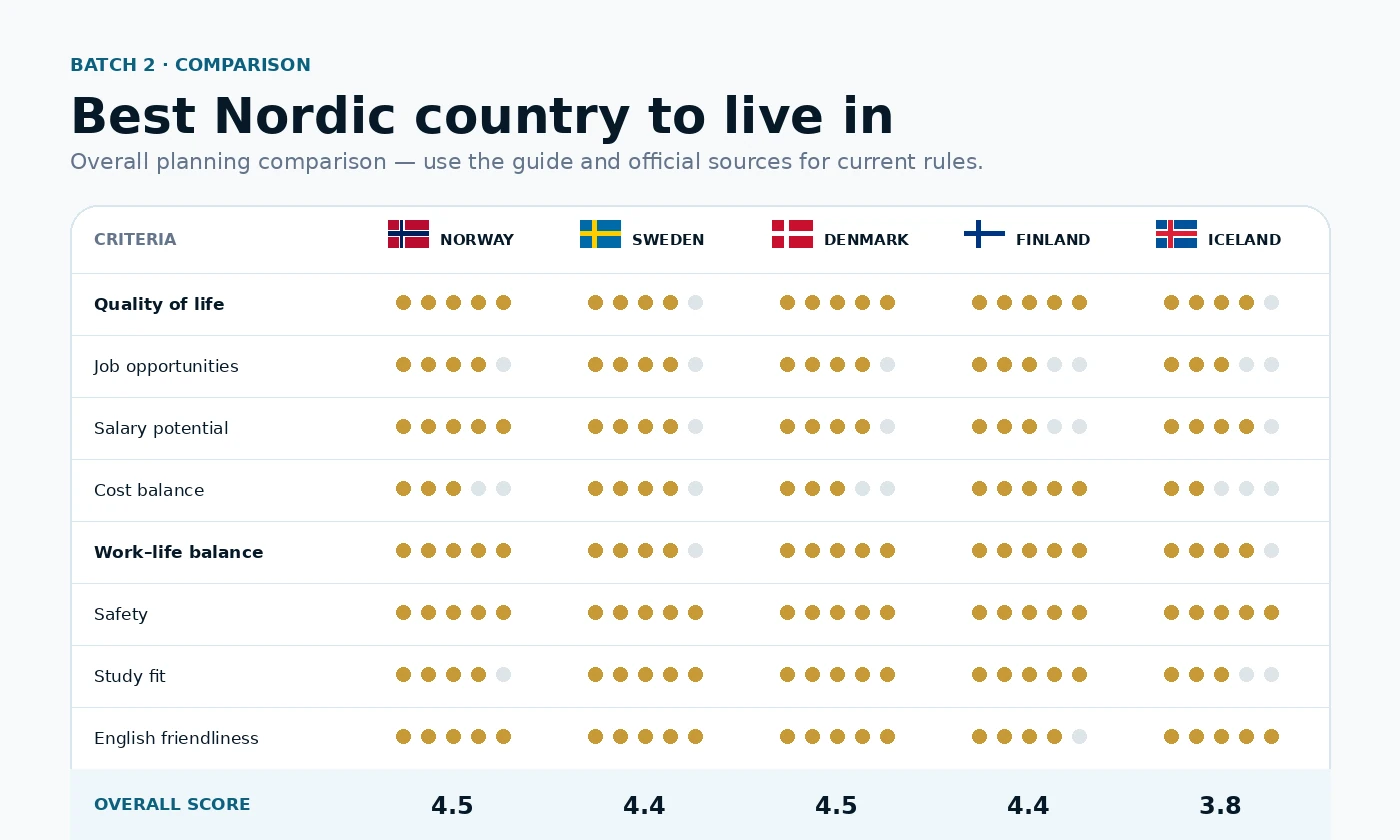
Norway can appeal for salary and nature, Denmark for compact urban life and cycling, and Sweden for city variety and a larger labour market. Those are only starting points; occupation, permit route and rent can reverse a broad preference.
Compare net salary and housing in a real target city instead of relying on national stereotypes.
- Norway: salary and nature trade-offs
- Denmark: compact cities and housing pressure
- Sweden: market size and city variety
- Check legal route first
Evidence for this section:
Planning a Scandinavia itinerary
A first itinerary should not attempt to cover every capital and fjord in one week. Choose a route theme: capitals, Norway scenery, rail, family travel or a slower two-country plan.
Travel time between regions matters more than the number of countries listed on the itinerary.
- Capitals route
- Norway scenery route
- Denmark-Sweden route
- Two-country slow trip
- Check seasonal transport
Evidence for this section: Visit Norway ↗ · Visit Denmark ↗ · Visit Sweden ↗
Still comparing?
Find a better country shortlist.
Use the quiz to narrow your research, then compare the result with the guides and current sources.
Useful tools
Try the numbers or checklist yourself.
Comparison
Nordic Country Comparison Tool
Weight comparable price-level, unemployment and annual-hours evidence across Norway, Denmark, Sweden, Finland and Iceland, then use the result as a shortlist before checking visas, jobs, housing and city costs.
Comparison
Best Nordic Country Quiz: Find Your Best Fit for Work, Study or Life
Choose a planning profile and transparent evidence weights to shortlist Nordic countries using comparable price-level, unemployment and annual-hours data, then verify legal, job, housing and city factors separately.
Travel
Nordic Trip Cost Calculator
Estimate a multi-country Nordic itinerary budget including daily costs, cross-border transport and a planning buffer.
FAQ
Frequently asked questions
What are the Scandinavian countries?
Denmark, Norway and Sweden in the standard narrow definition.
Why is Finland not Scandinavian?
Finland is Nordic, but it is outside the usual narrow geographic and linguistic definition of Scandinavia.
Is Iceland Scandinavian?
Iceland is Nordic and has Scandinavian historical links, but it is not normally in the narrow three-country definition.
What is the difference between Nordic and Scandinavian?
Nordic is the broader regional term; Scandinavian normally refers to Denmark, Norway and Sweden.
How we check this guideSources, boundaries and update checks
- Time-sensitive rules and statistics are linked to primary or official sources where available.
- Planning guidance is kept separate from legal eligibility, live availability and personal financial advice.
- Important dates and source checks are shown so you can re-verify changing information before acting.
Sources
Official and primary references
Open the references if you need to verify a rule, statistic or date before making a decision.
View 5 sources and verification dates
Nordic comparative statistics resource.
Checked: See page date
Official travel guide for Norway.
Checked: See page date
Official travel guide for Denmark.
Checked: See page date
Official travel guide for Sweden.
Checked: See page date
Official Eurostat comparison of 2025 price-level indices with EU=100.
Data period: 2025
Checked: 2026-08-12
Read next
Continue your research
Nordic Countries & Territories: The 5 Countries, Faroe Islands, Greenland, Åland and Svalbard
Understand the five sovereign Nordic countries, the Faroe Islands, Greenland and Åland in Nordic cooperation, plus Svalbard's special Norwegian status—and why immigration rules differ.
Best Scandinavian Country to Live In 2026: Norway vs Denmark vs Sweden
Compare Norway, Denmark and Sweden with the same 2025–2026 evidence on prices, labour market, tax, work hours and housing—then choose by job, city and family fit.
Scandinavia Itinerary: 7, 10 and 14-Day Route Ideas
Plan a Scandinavia itinerary across Denmark, Norway and Sweden with realistic routes for seven, ten or fourteen days, transport trade-offs and budget guidance.
Denmark vs Sweden: Salary, Tax, Cost and Lifestyle Comparison
Compare Denmark vs Sweden for salary, tax, jobs, rent, family life, language and lifestyle using practical decision questions and official-source checks.